See when tonight’s combination of signal and local conditions is most useful.
Aurora forecast
Aurora forecast and northern lights outlook
Aurora Beacon turns live space weather and the conditions in your local sky into a clearer answer about whether tonight is worth watching.
Local outlookSpace weatherCloud & darknessBest viewing window
A useful aurora forecast needs two answers
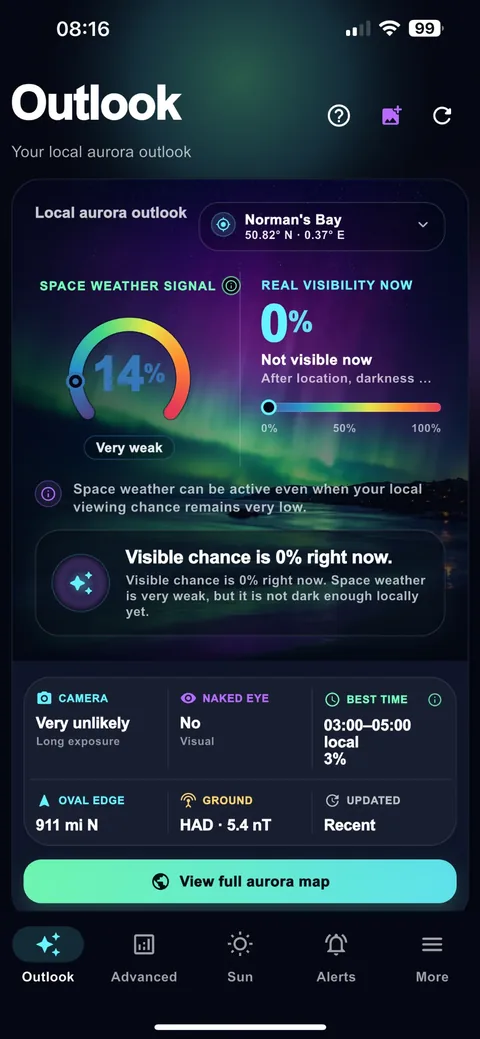
The first question is whether space weather is supportive of aurora activity. The second is whether the sky at your location gives you a realistic chance to see it. Aurora Beacon keeps those answers separate on Outlook and then turns them into practical guidance for tonight.
Space Weather Signal
Recent solar-wind and magnetic-field behaviour provide context for how supportive near-Earth conditions are becoming. Open the signal to inspect the recent trend rather than relying on a single rapidly changing number.
Real Visibility
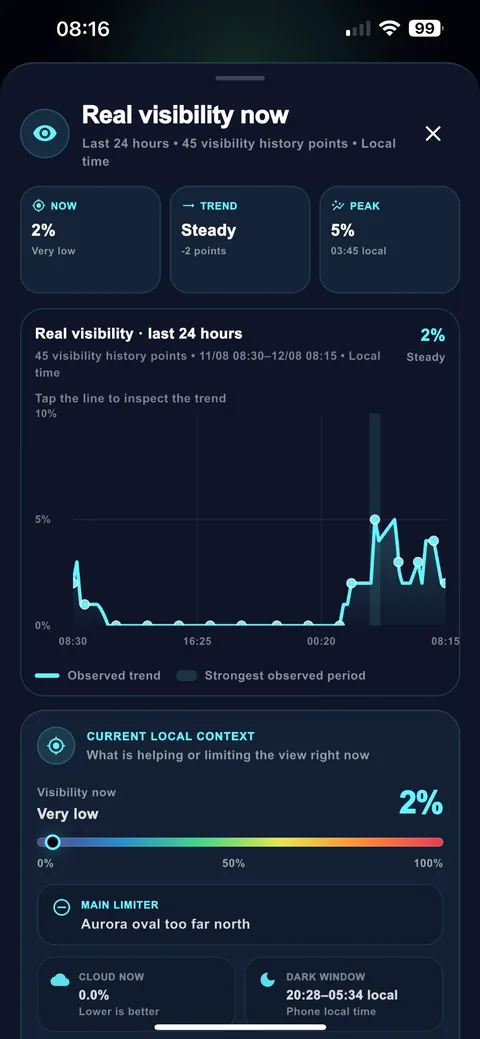
Darkness, cloud, Moon conditions and local observing context can turn a strong upstream signal into a poor viewing night—or make a modest event more worthwhile from the right place.
Why Kp is useful—but not a local visibility forecast
Kp describes global geomagnetic activity. An observer still needs to know whether it is dark, whether cloud blocks the useful part of the sky, how activity is evolving and whether nearby artificial sky glow is working against a faint display.
Inspect how conditions changed rather than judging the night from one snapshot.
Cloud, darkness or another local condition can be the reason not to travel.
Move from your local answer to the wider auroral oval when you need geography.
The forecast should help you decide what to do
A percentage is more useful when you can see what changed and what action follows. Aurora Beacon is designed around the next questions: should I keep watching, is there a better time later, would a darker location help, and what evidence is driving the current outlook?