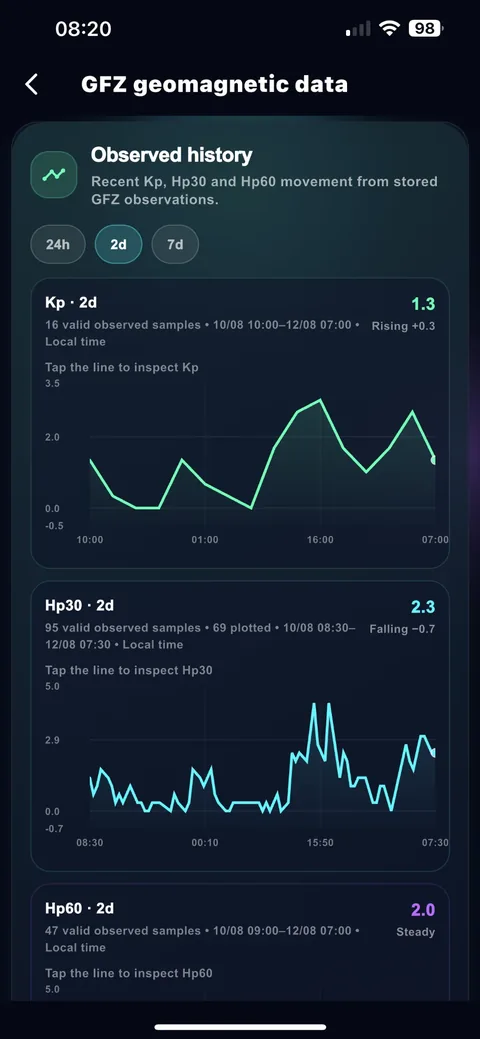
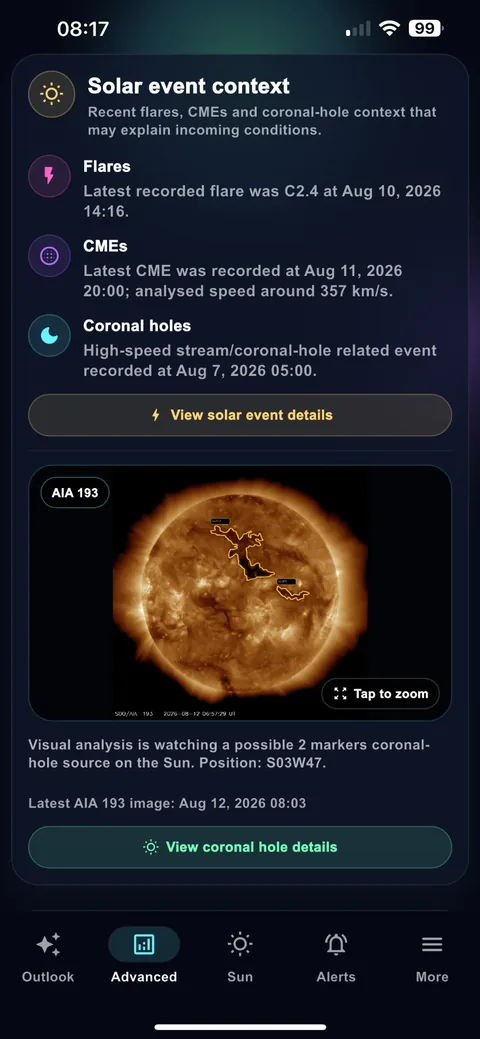
Solar imagery, flares, CMEs and coronal-hole activity provide source context.
Science & data
From solar activity to a local viewing decision
Aurora Beacon connects the space-weather evidence chain while keeping measured observations, uncertainty and its own derived interpretation as clear as possible.
Solar sourceNear-Earth solar windGround responseLocal visibility
No single number tells an observer enough
Aurora Beacon is built around a chain: what happened at the Sun, what the solar wind is doing near Earth, how Earth’s magnetic environment is responding, and whether the sky at your location is actually usable.
The app can combine those layers into a practical interpretation, but measured evidence and Aurora Beacon-derived intelligence should remain distinguishable.
The evidence chain
Bz, speed, density and related measurements show what is arriving near Earth.
Global indices and supported regional observations show how Earth is responding.
Darkness, Moon, cloud and local sky conditions determine whether an event is observable.
Derived means derived
Where Aurora Beacon calculates its own score, trend, classification, viewing window or interpretation, that output is an Aurora Beacon-derived product rather than an official observatory or agency index unless the screen explicitly says otherwise.
Regional evidence
Regional magnetometer coverage depends on supported networks, data availability and the terms attached to each provider. Regional evidence supplements rather than replaces the wider space-weather picture.
Forecast uncertainty
Aurora activity and visibility are uncertain by nature. The goal is to make that uncertainty more useful and explainable, not to pretend it can be removed.