Recent solar wind, magnetic-field behaviour and geomagnetic response show whether conditions are becoming favourable.
Northern Lights tonight
Can I see the Northern Lights tonight?
There is no single number that can answer that reliably. A useful decision combines aurora activity with the conditions in your actual sky: darkness, cloud, Moon, location, light pollution, horizon direction and timing.
Space weatherDarknessCloudMoonLocationHorizon
The short answer: activity and visibility both have to cooperate
A strong space-weather signal is not enough if it is daylight or the useful horizon is hidden by cloud. Equally, a perfectly clear dark sky does not create aurora activity. The best viewing decision comes from checking both sides of the problem together.
Darkness, cloud, Moon conditions and local sky glow determine how much of that opportunity is actually visible.
Start with a local outlook, not a global headline
Global indices are useful evidence, but they do not know whether your sky is dark or cloudy. Aurora Beacon keeps its Space Weather Signal separate from Real Visibility, then gives you a local outlook and the most useful viewing window.
Look for change, not just a snapshot
Aurora conditions can strengthen or weaken quickly. Recent trends help show whether the night is improving, fading or simply uncertain.
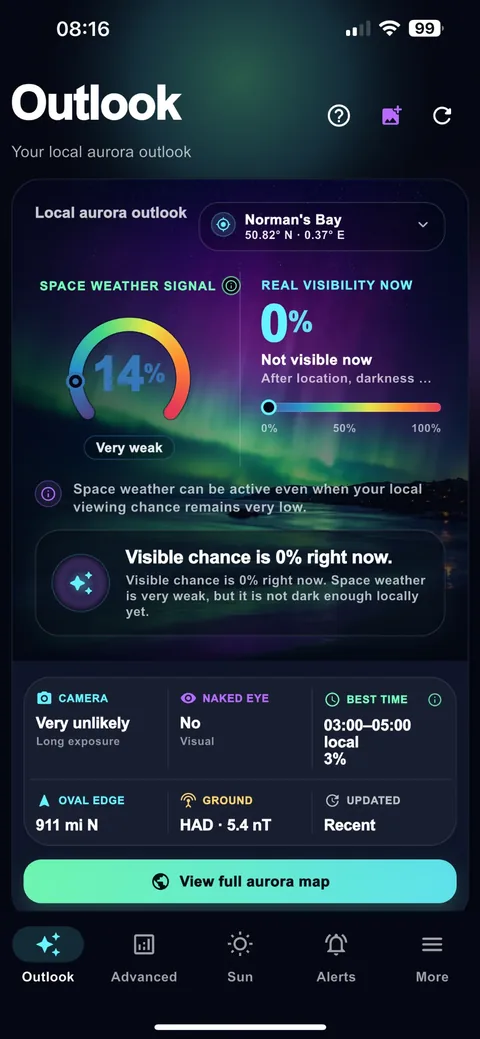
What to check before you go outside
Check whether the near-Earth solar wind and magnetic field are supportive and whether the trend is changing.
At higher latitudes in summer, true darkness may be brief or absent. Twilight can hide a weak display.
Cloud can be the decisive local limiter even during a strong geomagnetic event.
Moonlight does not make aurora impossible, but a bright Moon can reduce contrast for faint structure.
Your position relative to the auroral oval changes how strong an event may need to be before it becomes useful.
An open, darker horizon in the useful direction can matter more than simply driving farther away.
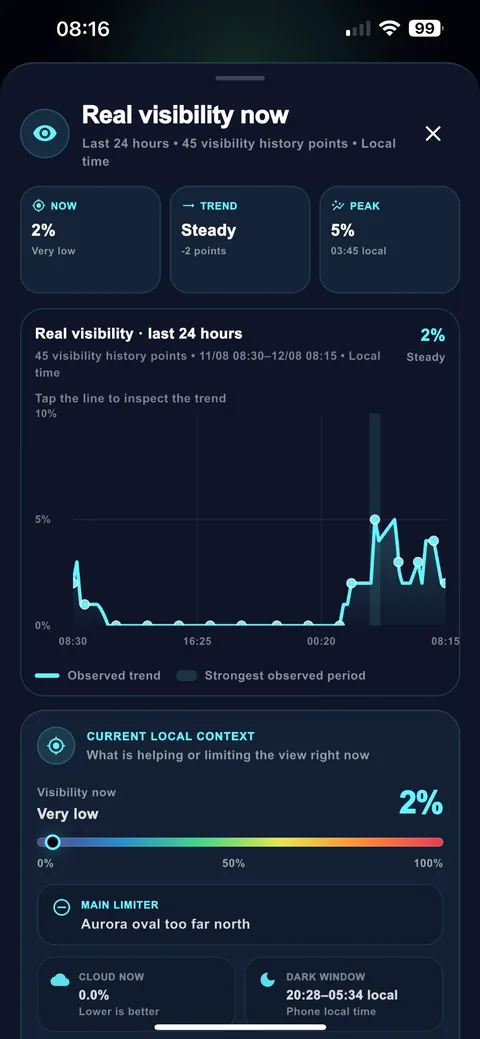
Why Kp alone cannot tell you whether you will see it
Kp is a global geomagnetic index. It is useful context, but it is not a local visibility forecast and it does not describe your cloud, darkness, Moon, light pollution or horizon.
For an observer, the practical question is not simply “what is Kp?” but “is the current activity enough for my location, and is my sky usable when it matters?”
Use this page as a checklist, not as tonight’s live forecast
This is an evergreen guide to the factors that matter when deciding whether to look for the aurora. It does not publish a live location-specific forecast. Aurora Beacon uses your chosen location and current data in the app to provide the live local outlook.
Aurora forecasting is uncertain by nature. Conditions can change quickly, and no forecast can guarantee that an aurora will be visible. Always make safe travel, weather, access and observing decisions independently.